1.2 Why is Coordination Needed
These entities function at many levels. Within the national level governments, frequently multiple branches (executive, legislative, judiciary) co-exist. Similar divisions may exist at the state/provincial level. There are also hundreds of lower-level entities, including counties, cities, and towns each with their own local government system. Further, even within a level and branch of government, there can be multiple divisions. For example, many towns have a planning department, a department of public works, and committees, such as for wetlands protection or health and safety.
While each governing unit has its own specific mission, goals, authorities, and responsibilities, the relationships between governing units vary. In some instances, each unit operates fully independently; in other instances, they are institutionally tied to one another; while in others, authorities and jurisdictions can overlap. Jurisdictional areas may intersect geographically, such as when the agencies cover some of the same “territory” (i.e. geographic, demographic, etc.), topically, such as when agencies address the same or related issue areas, or institutionally, such as when agencies are legally intertwined with one another. For example, higher levels of government may delegate decision-making to lower-levels governments. Lower-level units of government may also be subject to laws or regulations from higher-levels. Some interactions between governing units occur through designated roles within a process, such as when one agency sets standards that another is responsible for enforcing. Other interactions are more informal or ad hoc. Further, all levels of government interact with the many associations, community organizations, and individuals that have their own autonomy and influence environmental outcomes.
Box 1a. Institutional Fragmentation
Creation of new and restructuring of existing agencies is not uncommon. Institutional structures are changed as new circumstances or needs arise, in efforts to streamline processes or improve efficiency, and/or as part of political processes. As an example, in the aftermath of the Deep Horizon oil spill, the US Secretary of the Interior separated the US Minerals Management Service into three new agencies: the Bureau of Ocean Energy Management, the Office of Natural Resources Revenue, and the Bureau of Safety and Environmental Enforcement. The objective of this restructuring was to create a system through which safety management would be overseen independently from resource development and management, to provide a structure that ensured robust environmental analyses would be conducted, and to strengthen the role of environmental review and analysis.
This complex institutional structure for environmental governance results from the history human and societal development. Governmental structures and agencies are created and morph over time, in response to specific issues and changing needs and cultural paradigms (See Box 1a).
The complexity of institutional structures for environmental governance is also a reflection of the challenge of apportioning responsibility over socio-ecological systems. Due to the web of interactions within and between human and environmental systems, there is no perfect fit between jurisdictional authority and the issues that need to be addressed. Spatial and ecological boundaries generally do not align with the boundaries that define human governance regimes. Further, the boundaries of both ecological and human systems are not well-defined (See Box 1b).
Within ecological systems, there is no intrinsic unit around which to draw a boundary.13 Any one unit can often be divided into subunits. For example, a watershed may be based around first level a stream, yet a first-level stream is generally a tributary within a larger watershed, which may itself be a subunit of an even larger watershed.
Figure 1b: The Missouri River Watershed in the USA (light blue) is comprised of many subwatersheds, including the Missouri-Oahe watershed (medium blue), within which is the Apple Creek watershed, within which are multiple smaller subwatersheds (darker blues).
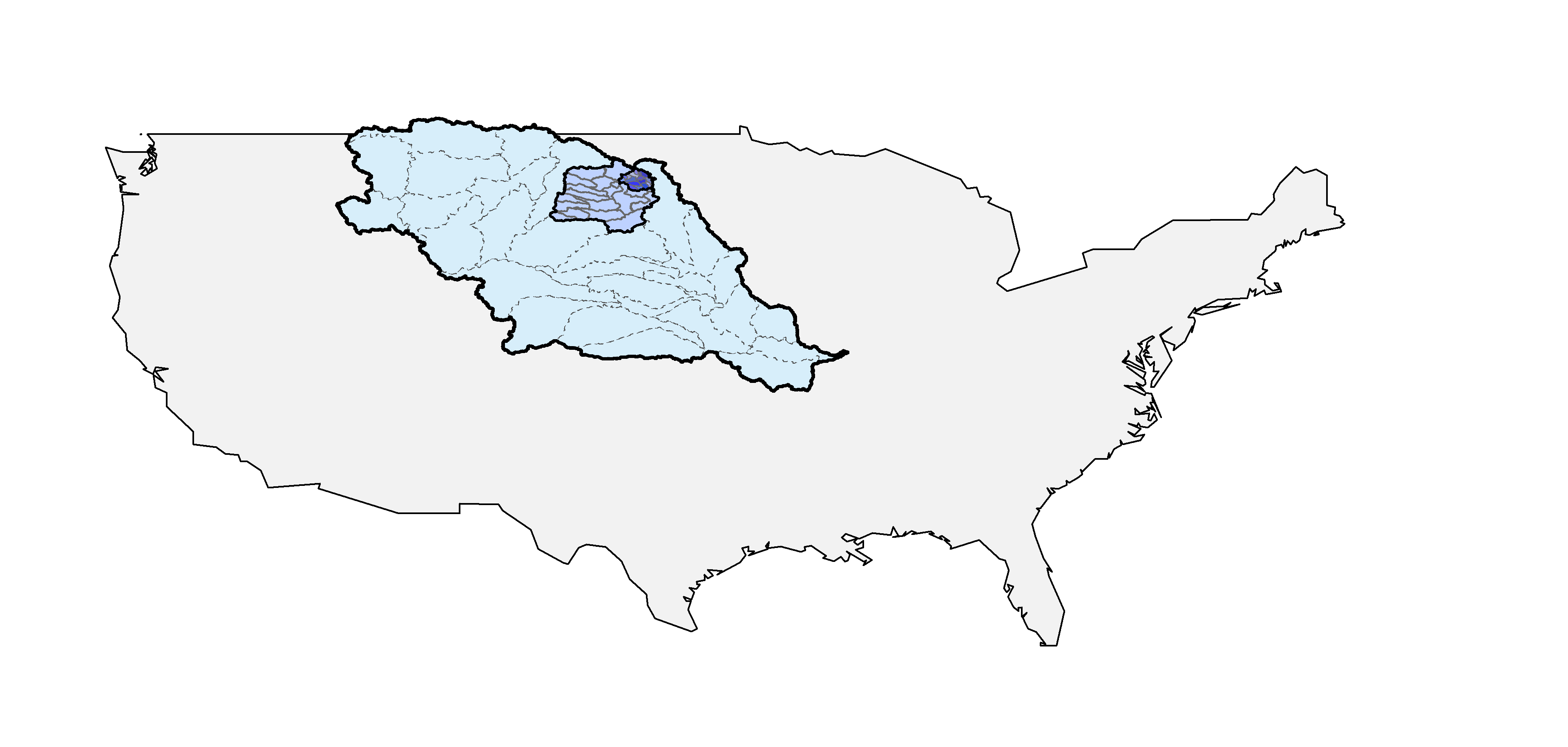
Complicating the selection of boundaries is the fact that natural resource systems are comprised of many interconnected physical processes. For example: the boundaries of a surface watershed do not necessarily match exactly with the boundaries of one of its groundwater basins. Moreover, human interventions often altered the physical boundaries of ecological systems. For example, diversions of water through canals may convey water from one watershed to another.
Human systems are as interconnected and overlapping as ecological systems, making it difficult to align the boundaries of any one governing unit with all facets of a social system.
Economic systems, political systems, and cultural systems intersect but generally do not follow the same boundaries. Natural resources are often governed by sector, yet activities related to one sector influence another. Further, broader economic and social policies also influence natural resources use and management. For example, water resources are tied to energy, agriculture, ecology, and recreation. Renewable energy policies that support hydropower may impact water deliveries for farming yet may also support boating and fishing in a reservoir. Even within a sector, there may be divisions. For example, water quality is generally addressed by environmental and public health authorities, while water quantity may be governed by natural resources or agricultural authorities. The combination of these multiple boundaries makes it extremely challenging, if not impossible for policies, programs, and projects implemented by any one governing unit or actor to span the full set of processes and actors that influence or are influenced by an environmental issue