4.3 Interoperability
One of the primary obstacles to sharing knowledge stems from interoperability issues. Interoperability refers to the technical ability and/or capacity to exchange and make use of information (see Box 4b). Issues with interoperability begin when data are collected and maintained by different agencies to meet their specific needs. This may result in data being collected, stored, and described using very different methods and protocols. The variation between agencies can make the process of aggregating data difficult or impossible.57 Overall, interoperability issues include problems related to data integration, storage and transmission, and administration.
Box 4b.The Challenge of Interoperability – Example Harmonization of Data along the United States and Canada Borderlands.
Agencies along the border between the United States and Canada often need to coordinate knowledge and information to address concerns about their shared waters. Hydrographic datasets for each country were developed independently, with their boundary as the international border. As a result there was some inconsistencies in the definitions and methodologies used, impeding seamless use of the data. The lack of a uniform dataset was a barrier to conducting detailed analyses of flows and water quality.
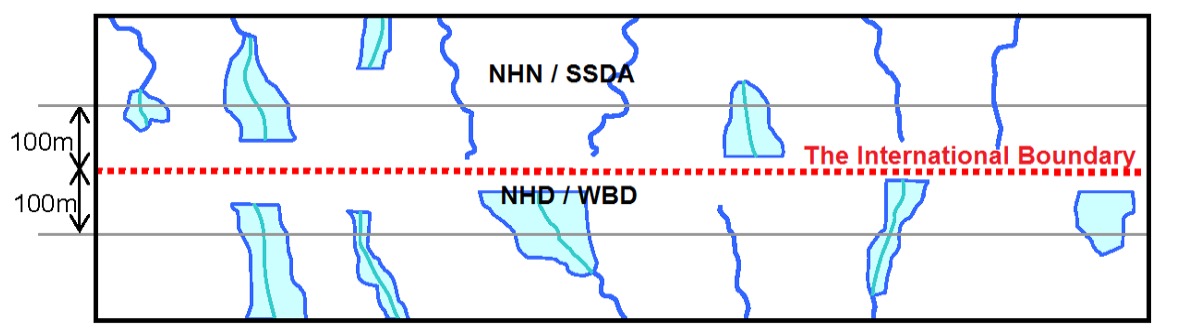
An example of disconnected geospatial data on transboundary watersheds that the Data Harmonization Task Force worked on harmonizing and joining. Photo and Caption Credit: Data Harmonization Task Force
To address this problem, the two countries set up a data harmonization task force, through which binational technical work groups reconciled and synchronized existing data, creating a new harmonized dataset for use now and into the future. For more see: International Joint Commission. Data Harmonization.
Data integration is the process of combining data so that it can be used jointly for evaluating trends, developing new understandings, answering specific questions, or creating models.58 There are multiple ways in which integrating data can be challenging, but one of the most significant issues is caused by differences between agencies in defining the system of study (e.g. differing definitions of what constitutes a “drainage basin”, differing definitions of the term “species”, etc.). Another frequent issue relates to incompatible data standards, which are the rules by which data are described and recorded. Well-implemented data standards result in a consistent format and meaning for the data.57 These standards address aspects such as the format of the data (e.g. character, numeric), measurement metrics (e.g. metric, imperial), and provide names, descriptions, and definitions of specific data elements. When consistently applied to metadata, data standards help users identify and discover relevant data.59 Overall, data standards improve a dataset’s usability by helping to clarify ambiguous meanings, minimize redundancy, and improve accuracy.
In addition to incompatible data standards, issues due to different data collection techniques are a common cause of data integration problems. When agencies use distinct methods for collecting data, such as utilizing different technologies for measurement or different schedules for collecting data, these disparate methods may result in data that are incompatible to combine. Additionally, if clean datasets or analyses are not available across agencies within agreed-upon timeframes, larger-scale analyses must be delayed until all data can be aggregated.
Data integration is similarly impacted by issues related to variable quality data. Even when agencies use compatible methods to collect the data, variable data collection techniques can result in data that is less precise or less accurate than other data (e.g., using measurement instruments with different levels of accuracy). This variability can potentially cause problems when combining the data. Additionally, the training and capacity of the personnel collecting the data may impact the accuracy or precision of the data being collecting. In these cases, combining the data may lower the overall quality of the dataset, which in turn can limit a coordinating agency’s willingness to utilize the data.
Outside of data integration issues, further interoperability issues may still arise if there are technical issues with storing or transmitting data. These issues include hardware and software incompatibilities between the entities collecting, aggregating, analyzing, or interpreting the data. Technical issues are especially likely to arise when hardware or software become obsolete or when there is limited information technology (IT) capacity to assist with maintenance or training in data storage/transmission systems. Technical interoperability issues also frequently occur when trying to integrate digitized information with handwritten data, such as field notes or historical maps.60,61
A final common cause of interoperability challenges is due to data administration issues. These challenges include situations related to personnel capacity, such as limitations on the staff time available for data sharing tasks like report writing or computer programing. There may also be financial limitations, especially if a third party is needed to oversee data-sharing responsibilities or if budgetary cycles affect long-term planning for data sharing activities.61 Obtaining permission to share data can also pose an administrative challenge, especially if the nature of the data is sensitive or proprietary. Agencies may need to ensure that they have the legal authority to share their data, and employees may need specific authorization and training to share data. Lastly, if agencies wish to implement long-term information sharing strategies, they must ensure that their process is clear and well-documented so that new employees or third parties can continue the established protocols.60