2.3 The Decision Making Process
While membership determines which agencies have a role in the decision-making process, representation determines the relative level of influence each of these agencies will have on the decision-making process. In addition,decision rules detail the process that will be used to determine how agencies jointly engage in decision-making. Agreements between agencies may include a provision about representation to ensure that each entity has an appropriate and agreed-upon designation of power. Examples of representation structures include one-vote-per-member, proportional voting, and multi-tiered voting, all of which we will discuss here (See Box 2c).
Box 2c. Structures for Representation, Voting, and Decision-making – Example from California
In California, agencies working together to develop a joint groundwater sustainability plan adopted a variety of institutional structures for plan development. Below are four examples of structures adopted.
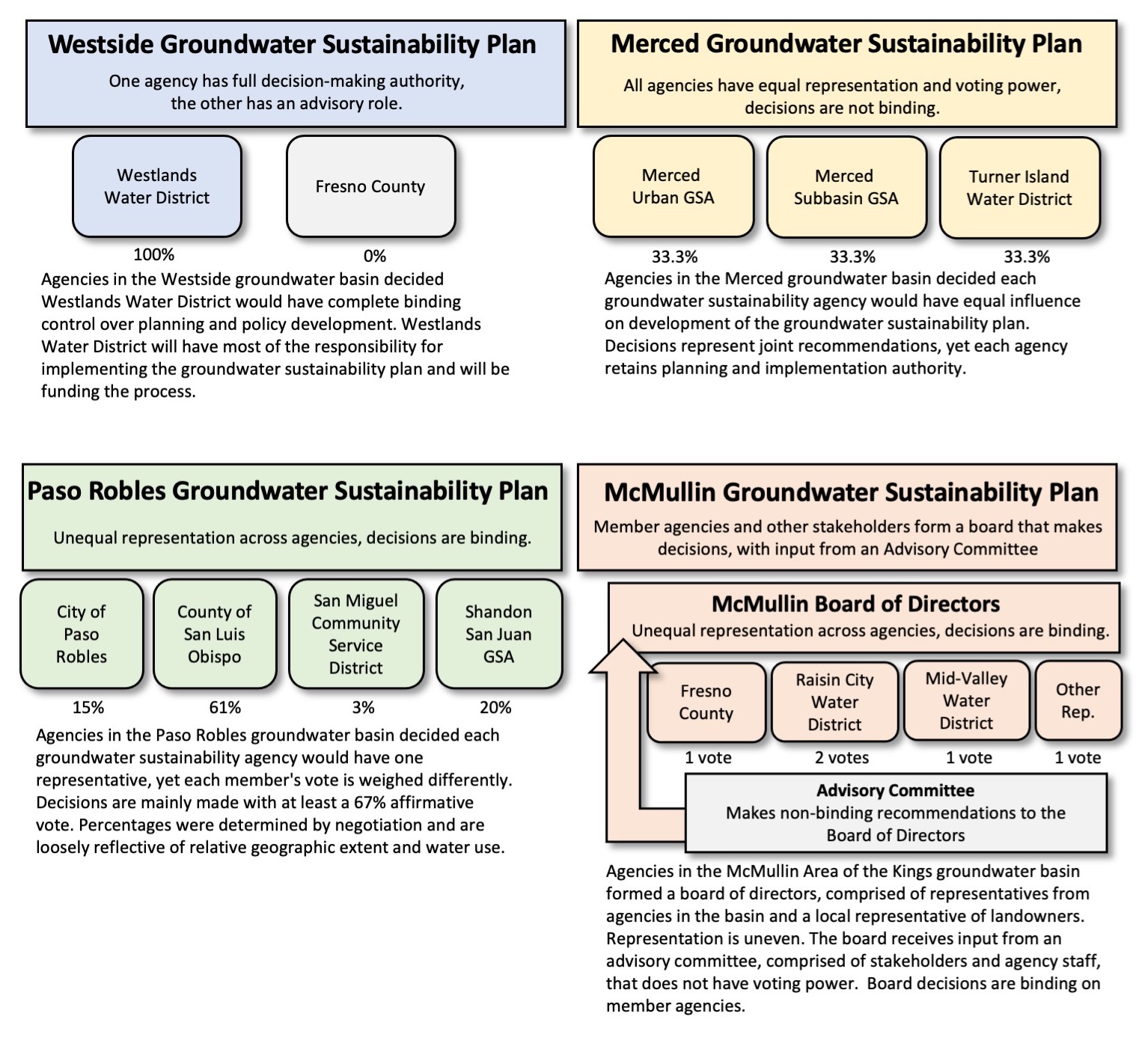
One of the simplest ways to designate power in an agreement is to give one vote to each member. In this system, typically a quorum must be present, and a decision is made based on the number of votes from the majority of the governing members present. This system of representation may be ideal for parties that wish to have an equal voting structure that is easy to understand. In addition to allocating votes across members, decision-rules (see below) also structure how power is exercised within the agreement.
Another method for allocating voting power is through proportional voting. Instead of giving one vote to each member, this system assigns voting power proportionally based on another factor. Common factors used in agreements include the proportion of a shared resource allotted to each member or the amount of financial contributions from each member. Instead of giving each member an equal voice, this system distributes power based on the relative impact a decision may have on each member. This structure might be particularly desirable in situations where members do not have equal financial obligations to the agreement, or where natural resources are not equally accessible to each voting member.28
A voting system that combines one-vote-per-member and proportional voting is called multi-tiered voting. Coordinating agencies that use this system may contain multiple sets of voting bodies, each specializing in a certain subject. A matter before the general governing board may need to be approved by a majority in a one-vote-per-member system, and then confirmed by a second voting body that specializes in that subject based on the proportional voting system.28 Multi-tiered voting may be ideal for complex agreements involving many parties, or for specific topics like budgeting where parties may be disproportionally affected by a decision.
In terms of decision rules, common processes include consensus, unanimity, majority voting, and super-majority voting, each of which we will describe here. The system best-suited for a coordinating group will depend on the nature of the parties involved, any prior relationships they have regarding coordination, and the types of decisions they will be making.
Consensus is an informal decision-making process. A consensus is achieved once a decision is formulated that no party disagrees with.32 This decision-making strategy involves group discussions to ensure that each party’s opinions are understood, therefore requiring high levels of participation and cooperation. This process helps coordinating parties move forward with a common decision, but it can take more time and effort from each party than other forms of decision-making.33
Unanimity is a formal decision-making process. Unlike consensus – where no one entity disagrees – unanimous decisions occur when every party specifically agrees to the proposal. This decision-making rule gives all parties equal power, which may be important for decisions with highly significant consequences or for parties that are distrustful of each other. However, the requirement for unanimity may inhibit the group’s ability to reach an agreement, even when the bulk of the participants agree, because this structure effectively gives each party veto power.34
Like unanimity, majority voting is a formal decision-making process. However, a majority voting system requires only a simple majority to agree for a decision to be made.35 Therefore, a majority voting system relies on the principle that decisions can be made based on what the larger proportion of the parties agree upon, regardless of the impact of the decision to those in the minority. While this system reduces the deliberation time needed to come to a decision, it does not necessarily maximize the welfare of those in the minority. This is especially true if the relative impact of the decision varies greatly between the majority and minority.
A super-majority is another type of formal decision-making rule which requires more than 50% of voters to agree. Often, a super-majority requires either 2/3 or 3/4 of the parties to agree in order to make a decision. A super-majority system is one method for balancing the benefits and drawbacks between majority rule and unanimity. A super-majority encourages deliberation and compromise between more of the parties involved, while preventing any one party from stopping the decision-making process from moving forward.
Irrespective of the method of aggregating parties’ voices into a decision, there remains the question of how those decisions translate into commitments. Binding decisions are those that legally bind the parties affected by it. These decisions are enforceable, although the method of enforcement may be variable depending on the type of agreement. In contrast, a non-binding decision is a resolution that expresses approval or disapproval yet does not hold the force of commitment. A non-binding decision may take the form of a recommendation, letter of intent, or memorandum of understanding. In inter-agency coordination, an executive board or coordination committee may have the authority to make binding decisions that commit member agencies to their resolutions. In other decision-making systems, the executive board or coordination committee may only have the authority to make strong recommendations to member agencies, and member agencies must individually approve the decision for it to go into effect.28