2.4 Decision Rules
While developing processes for parties to engage in joint action and decision-making is critical to coordination, also needed are processes for resolving differences between parties and options for terminating the coordination agreement. Coordinating agencies may decide to include provisions in their agreements regarding dispute resolution with the goal of avoiding litigation, such as arbitration, mediation, negotiation, or administrative appeals.27 Agencies may also find it prudent to decide on a structure for exiting the agreement (See Box 2d).
Box 2d. Termination Clauses in Agreements – Example from California
Agencies entering into agreements under California’s Sustainable Groundwater Management Act included a variety of rules and conditions that must be met for any agency to either exit from or terminate the agreement. Below are examples of rules and conditions used in termination agreements.
Voting rules dictate the process through which a decision to terminate the agreement will be made.

Unanimous Vote: Both the Merced Subbasin Agreement and the Tri-County Agency Agreement require a unanimous vote of members prior to termination.
Majority Vote: The Eastern San Joaquin Planning Group Agreement states a majority vote of members is required to terminate the Agreement. Upon termination, the agencies will remain responsible for their share of any obligations incurred by the planning group and any assets of the authority will be divided proportionally among the agencies, assuming no public entity follows.
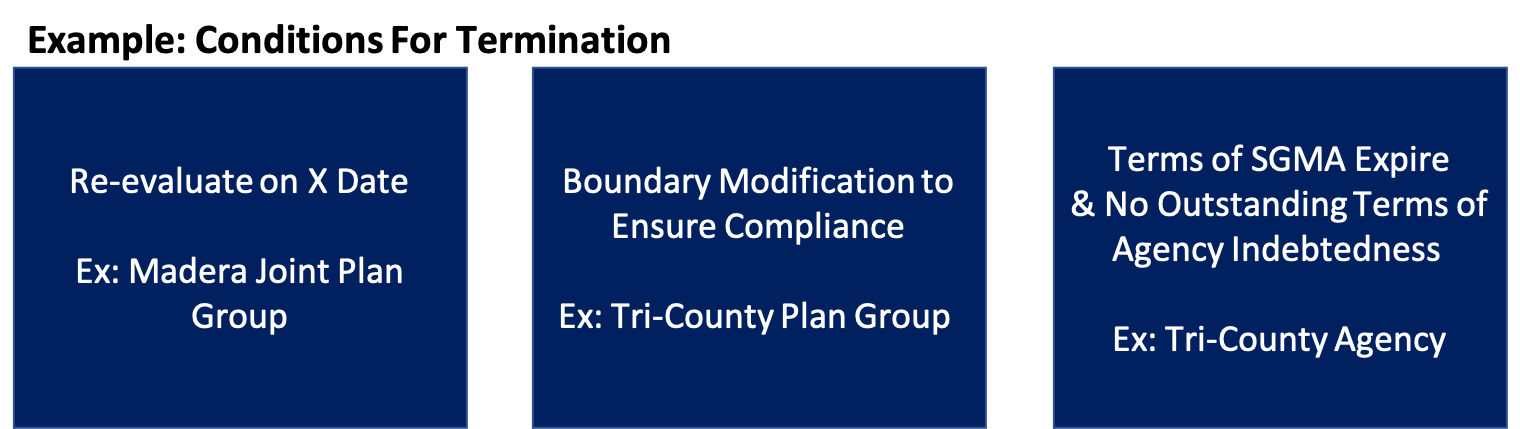
Re-evaluation: The Madera Joint Plan Group Agreement states that the agreement will continue until October 2019. At that point in time, the group members will decide whether the agreement will continue or if it should be terminated.
Boundary modification to ensure compliance: The Tri-County Plan Group Agreement states that it can only be terminated upon modification of agency boundaries to ensure the entire geographic expanse of the groundwater sustainability plan is under the jurisdiction of an agency that is part of the agreement.
Expiration of terms of SGMA and no outstanding terms of agency indebtedness: The Tri-County Agency Agreement states that no members can terminate the agreement before 2040. Additionally, an agency can only exit the agreement if that has no outstanding terms of indebtedness.
Arbitration is a process through which the parties refer a dispute to an agreed-upon, independent third party for resolution.
Mediation, in contrast, is a process by which a neutral person facilitates a discussion between the disputing parties and assists them with reaching an agreement themselves. Similar to mediation, negotiation between parties is an attempt to reach agreement through discussion and compromise, but it does not usually involve a third party. Lastly, administrative appeals are an appeals process that allows individuals to request that a decision be reversed by a committee or governing board.27
If a major dispute between members of a coordinating group cannot be resolved, or if the coordination is no longer in an agency’s interests or no longer necessary, a member may wish to withdraw from the agreement. Formal agreements commonly contain provisions regarding the policy and procedures for member withdrawal and agreement dissolution. For example, withdrawal provisions may instruct all parties to bring disputes to the executive committee before withdrawing from the contract. Another common requirement is the formal notification of withdrawal to the other parties in the contract and the fulfillment of outstanding obligations. Dissolution clauses may include procedures regarding the return or transfer of funds and property. The inclusion of withdrawal or dissolution provisions in a coordination agreement provides guidance that may reduce major conflict and improve efficiency during times of disagreement or transition among the parties.28